
Learning Philosophy
The experiences and philosophy that shape my approach to learning design.
Why Human Praxis
I've always been curious about learning.
Not because I wanted to become a teacher, but because I wanted to better understand myself. Why do some ideas stay with us while others are forgotten? Why do some experiences change the way we think? And what transforms knowledge into something we can actually use?
As I studied educational psychology, completed my CELTA certification, and later worked with adult learners in classrooms, workplaces, and community settings, I kept returning to those same questions. The contexts were different, but the patterns were remarkably consistent. People rarely learn because they're simply told something. They learn when they actively engage, connect new ideas to what they already know, reflect, practise, and apply what they've learned.
I didn't discover these principles—I simply had the privilege of watching them come to life again and again. Those experiences reinforced something I now carry into every learning project: effective learning isn't about delivering information. It's about creating the conditions where people can build confidence, develop capability, and apply what they've learned in meaningful ways.
Before designing a workshop, course, or learning experience, I want to understand the learner. What challenge are they trying to overcome? What's standing in their way? What capabilities do they need to develop? Understanding the learner and the problem always comes before designing the solution.
For me, success isn't measured by what happens during a workshop. It's measured by what happens afterward. Do people think differently? Do they approach challenges with greater confidence? Can they apply what they've learned to solve real problems? Those are the outcomes that matter.
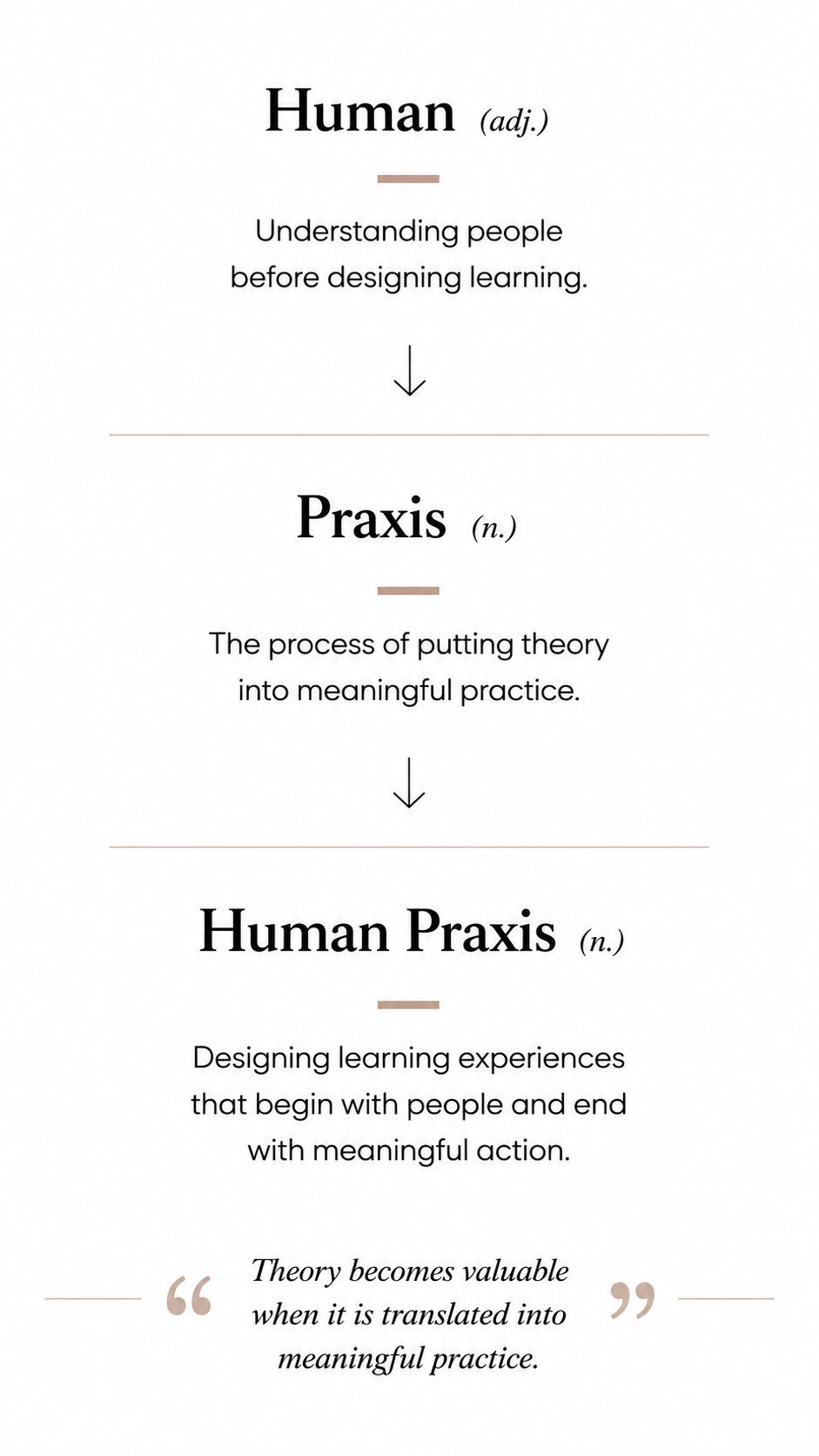
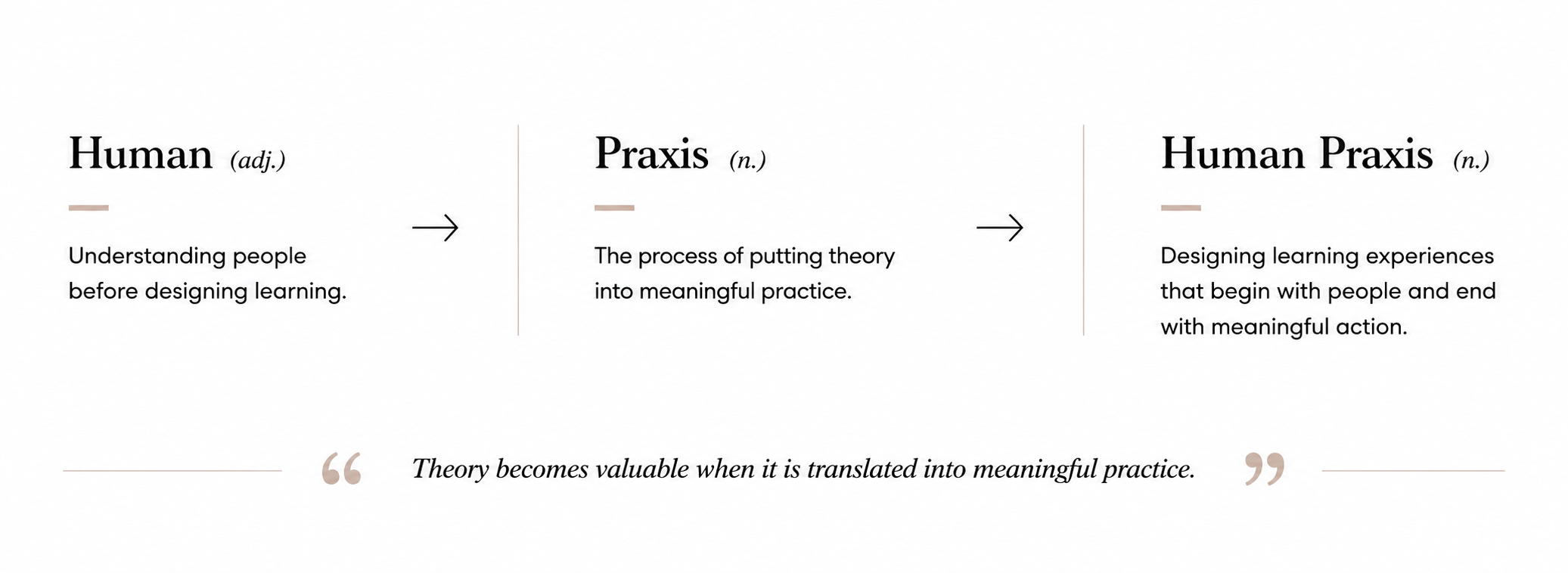
The name Human Praxis reflects the philosophy that guides my work.
Human represents my belief that meaningful learning begins with understanding people—their experiences, motivations, strengths, and challenges.
Praxis is the process of putting theory into practice. Knowledge reaches its greatest value when it's translated into meaningful action.
I don't believe learning experiences transform people. People transform themselves. My role is to thoughtfully design the conditions that help make that transformation possible.

Experiences That Shaped My Thinking
Every learning environment I've worked in has taught me something different about how people learn. Looking back, I can see that these experiences didn't change my philosophy overnight. Instead, each one added another layer to the way I think about designing meaningful learning experiences.
Learning Is Co-Created
One of my earliest experiences as an educator was teaching English to adult learners from around the world. Every classroom brought together people with remarkably different stories and backgrounds—engineers, dentists, business owners, parents, homemakers, and professionals who had built successful careers before immigrating to Canada. They weren't simply learning a new language; they were building new opportunities, navigating unfamiliar systems, and creating new lives for themselves.
What surprised me most wasn't their diversity—it was their motivation. They came because acquiring English represented possibility. For some, it meant finding meaningful employment. For others, it meant pursuing further education, navigating everyday life with greater independence, or simply feeling more connected to the community around them. Learning wasn't an end in itself—it was a pathway to something larger.
I also discovered that many learners possessed more knowledge and ability than they realized—they simply needed the confidence to use it. Speaking in a second language requires vulnerability. It means taking risks, making mistakes, and expressing yourself before you feel ready. I began to notice that as the classroom became a place where mistakes were treated as a natural part of learning, quieter students gradually found their voices. Learners who had once hesitated to participate began asking questions, sharing stories, supporting one another, and building friendships through the language they were learning together.
Those experiences changed the way I thought about teaching. I realized that my most successful lessons weren't necessarily the ones where I explained concepts most clearly. They were the ones where learners felt safe enough to participate, contribute, and learn from one another. My role shifted from being the primary source of knowledge to designing the conditions where meaningful learning could happen.
That lesson has stayed with me ever since. Whether I'm designing a workshop, facilitating a discussion, or developing learning resources, I begin with the learner. People don't arrive as blank slates—they bring knowledge, experiences, perspectives, and strengths. Thoughtfully designed learning creates the conditions where those qualities can be shared, expanded, and transformed into new capability.
Learning Continues Beyond the Classroom
Working in Human Resources at the Hyatt expanded my understanding of what workplace learning could be. Until then, much of my experience had been in classrooms, where learning often had a defined beginning and end. Hyatt showed me that meaningful learning continues long after a formal training session is over.
Although onboarding provided an important foundation, much of an employee's growth happened in the workplace itself. New skills were reinforced through coaching, feedback from managers, daily practice, and real interactions with guests. Learning wasn't a single event—it was an ongoing process supported by the people and environment around it.
I also came to appreciate the importance of designing learning with a clear purpose. Many of the employees I worked with voluntarily attended English coaching outside of their regular workday because they understood how stronger communication skills would help them perform their roles, connect more confidently with guests, and continue growing professionally. Their motivation wasn't driven by completing a course; it came from seeing how learning could help them achieve meaningful goals.
Working alongside HR also broadened my perspective. I began to see learning not only as a way to support individual growth, but as something that contributes to team performance, organizational culture, and the overall experience of the people an organization serves. A thoughtfully designed learning experience can create value far beyond the classroom.
That experience reinforced another belief I continue to carry into my work today: learning doesn't end when a workshop concludes. Meaningful change happens as people apply new skills, receive feedback, build confidence through practice, and integrate learning into their everyday work.
Every Person Brings Knowledge Worth Sharing
Facilitating groups at the Allan Memorial Day Hospital and Ometz deepened my understanding of what it means to create meaningful learning experiences. Many participants weren't coming to develop technical skills or gain professional knowledge—they were navigating significant mental health challenges that affected their confidence, relationships, emotional regulation, and daily lives. They arrived carrying experiences that couldn't be separated from the learning process itself.
What surprised me most was that meaningful learning didn't happen because I had the answers. It happened when I stopped feeling responsible for being the expert and focused instead on creating a space where people felt respected, validated, and safe enough to share their own experiences. As trust developed, participants began learning from one another—offering strategies that had helped them, asking thoughtful questions, building on each other's ideas, and discovering they were not alone in their struggles.
Facilitating the Wellness Recovery Action Plan (WRAP) strengthened this perspective even further. One of WRAP's guiding principles is that people are the experts in their own lives. Rather than prescribing solutions, the process encourages individuals to reflect on their own experiences, recognize their strengths, identify what supports their well-being, and learn from the collective wisdom of the group. I witnessed firsthand how empowering it can be when people begin to trust themselves and realize that their experiences can also support the growth of others.
These experiences transformed the way I think about learning. I came to see that meaningful learning isn't created by simply delivering information—it's created by designing environments where people feel safe enough to reflect, contribute, ask questions, and connect new ideas to their own experiences. Every learner brings valuable knowledge, perspectives, and strengths that can enrich the learning experience when given the opportunity to contribute.
What Connects It All
Looking back, I can see that each experience taught me something different about how people learn. Yet despite the different settings—from language classrooms and corporate workplaces to community organizations and mental health groups—the underlying principles remained remarkably consistent. People learn best when they feel safe to participate, can connect new ideas to what they already know, see purpose in what they're learning, and have opportunities to apply it in meaningful ways.
Whether the learning experience takes place in a classroom, a workshop, or a digital environment, my role remains the same: to thoughtfully design the conditions where meaningful learning can happen.
Continue Exploring
If you'd like to see how these ideas come to life, explore a selection of my instructional design projects.
View Portfolio →